A 70's Thor Retrospective
The 70’s were a decade of ups, and really low lows. I mostly attribute this to the decade’s main writers. Conway and Wein.
But Stan Lee started off this decade, with the first of a few ‘Thor Dies’ arcs. These arcs really do weigh down the first part of the 70’s especially during the tail end of Lee’s run into Conway’s. I suppose this was done to sell comics, but despite the stakes seeming very high, they really aren’t.
1971 is also the year of the worst Loki design, in an arc where he takes Odin’s ring and rules over Asgard, forcing Sif to be his bride.

This entire issue brings up an issue I will have with the entire decade as a whole, and an issue I have with Conway’s writing up until the end of his run. Which is the treatment of Sif. As of now she is nothing more than another damsel in destress, given a sword and armor. When faced with any resistance or threat - she faints. This goes against her first introduction in Lee/Kirby, where we were told that Sif is on par with Thor in her abilities but we rarely see that. It’s an issue that all female characters face at this time, but its especially jarring with her. Mostly due to what happens in issue #196 and later in the run.
Sif and a new character; Hildegarde, are sent to Blackworld. For…reasons…. But while Sif and Hildegarde are alone, we see Sif able to take care of herself and to fight. Is this a strange fear of female characters showing up male ones? And is why Sif doesn’t fight while she’s around Thor. It’s annoying to me, and continues to be annoying. Maybe I’m used to the more modern depictions of Sif, but I prefer her when she is as she’s advertised.
Enough about Sif, we’ll come back to her. I suppose I get so up in arms about her treatment because I want the best for her, and we rarely get the best for any female character. Especially in this era of comics.
The best way I can describe Conway’s run is dense. It’s dense with the fake Shakespearian dialogue and exposition about space wars and alien races that have nothing to do with anything. Even as we build up to the 200th issue with the introduction of Ragnarok, our characters are left dealing with old timey sea captains from another world and alien civil wars.
Issue 200 is a bit of a standout, where Lee comes back to write about Ragnarok. It’s effectively what we as modern readers already know, and differs from the mythology. This rendition of Ragnarok will also get retconned by another writer in 60 issues. So don’t grow too attached to it.
That brings up another issue I have with Thor comics in general, and it’s the interpretation of the myths by different writers. Marvel Thor mythos deviates greatly from the ‘canonical’ Norse myth. Partially due to the Marvel mythos being introduced in the 60’s, a time where knowledge about mythology wasn’t as common, and you couldn’t just google the Poetic Edda and pull up a lovely web 2.0 site to read it on.
This may be controversial, but I really don’t care if my stupid comic book doesn’t completely match Norse Myth 1-to-1. Marvel Thor isn’t mythological Thor, Sif isn’t Sif, There’s no Freyja and Loki’s role has been changed so much that he’s barely even like his namesake. These inaccuracies are brought up much later in the 70’s, and it creates such a confusing mess of what’s canon, what’s not canon, what should be canon and who even cares. If I want something mythologically accurate I’ll read the Poetic Edda again or watch the God of War: Ragnarok cutscenes. (Love that Thor design btw)
Continuing on with Conway, we eventually return to earth and fight normal supervillains. But we have an added bonus of the other Asgardian’s joining Thor on earth. I love the silly little slice of life interjections with the Warriors Three learning about tv and lemonade and other modern 70’s amenities that NYC had to offer. I do have to say, if you like the Warriors 3, this is a pretty good run for them.
But alas, Earth time comes to a close and we must return to space. Where there is exposition about space battles and Odin is put in chains and enslaved (yes he is also shirtless). The hard sci-fi turn that Conway takes is not my preference, and we’re given villains of the week such as the 4-D Man! Xorr! And Odin! Wait what? There’s another space battle arc about the Black Stars, who attack the Colonizers (who are allies) and their other big villain Avalon!
But wait, Avalon says the Black Stars are bad? And there’s another master manipulator behind the scenes! It turns into a Jailer from Shadowlands situation where things become too big and complicated and eventually just fizzles out into nothingness. That’s another staple for this run. If you like sci-fi and aliens and gods based off of Norse mythology fighting aliens then this run is for you. There’s no Loki schemes, there’s no Midgard drama. It’s just… space battles. Luckily this does die down a bit after issue #220, where we are brought back to the world of Myth and we get to see Olympus and Hercules again. Our big bad is one from myth, Pluto; The Roman God of the Underworld. Who is sort of rehashing the myth of Hades and Persephone, with Pluto kidnapping Hildegard’s sister, Krista.
Because if there’s going to be a female character. She’s going to be a damsel in destress.
In #222 we see the first instance of Thor and Herc having an arm wrestling match, something that’s come to be a pretty common trope between the two of them. I like 2love it when they test their might against one another and this is such a fun way to show it.
This entire arc with Pluto is suddenly interrupted by a NEW herald of Galactus showing up. This time it’s Firelord. In which we are graciously introduced to his butt on the cover. Firelord has come to Earth because Galactus said so, and he came to seek out Thor. (And call Herc an idiot)
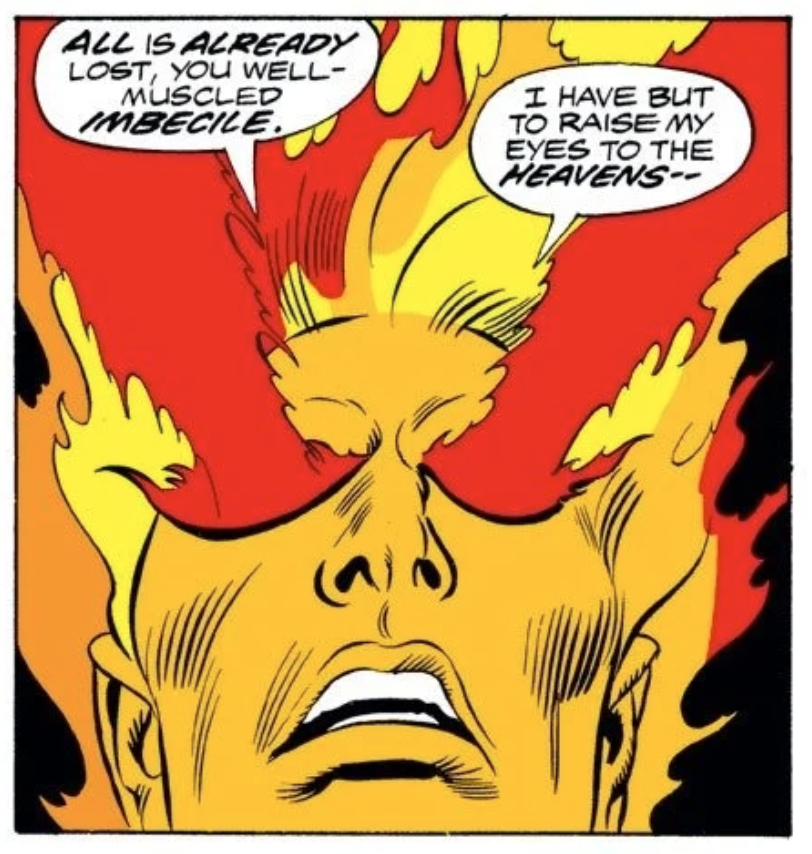
We also find out that in this issue Odin knows about Reed Richards, so that’s fun. But yes, Galactus is coming back from the Negative Zone and he’s HUNGRY (for revenge)
Pluto is still an issue but this isn’t about him right now. We saved the damsel in distress so that whole arc petered out into a simple, and rather boring, Destroyer fight.
But wait! We find out that Galactus is actually rearing up to fight Ego the Living Planet! Which means we’re back in space.
Woo hoo.
We do get to learn about Ego’s backstory through a large exposition dump given to us by an alien race we’ve never seen before and will never see again. Egros, the man who became Ego, was a part of the last living members of his race, created these pods to keep his people in so they may survive the destruction of their planet.
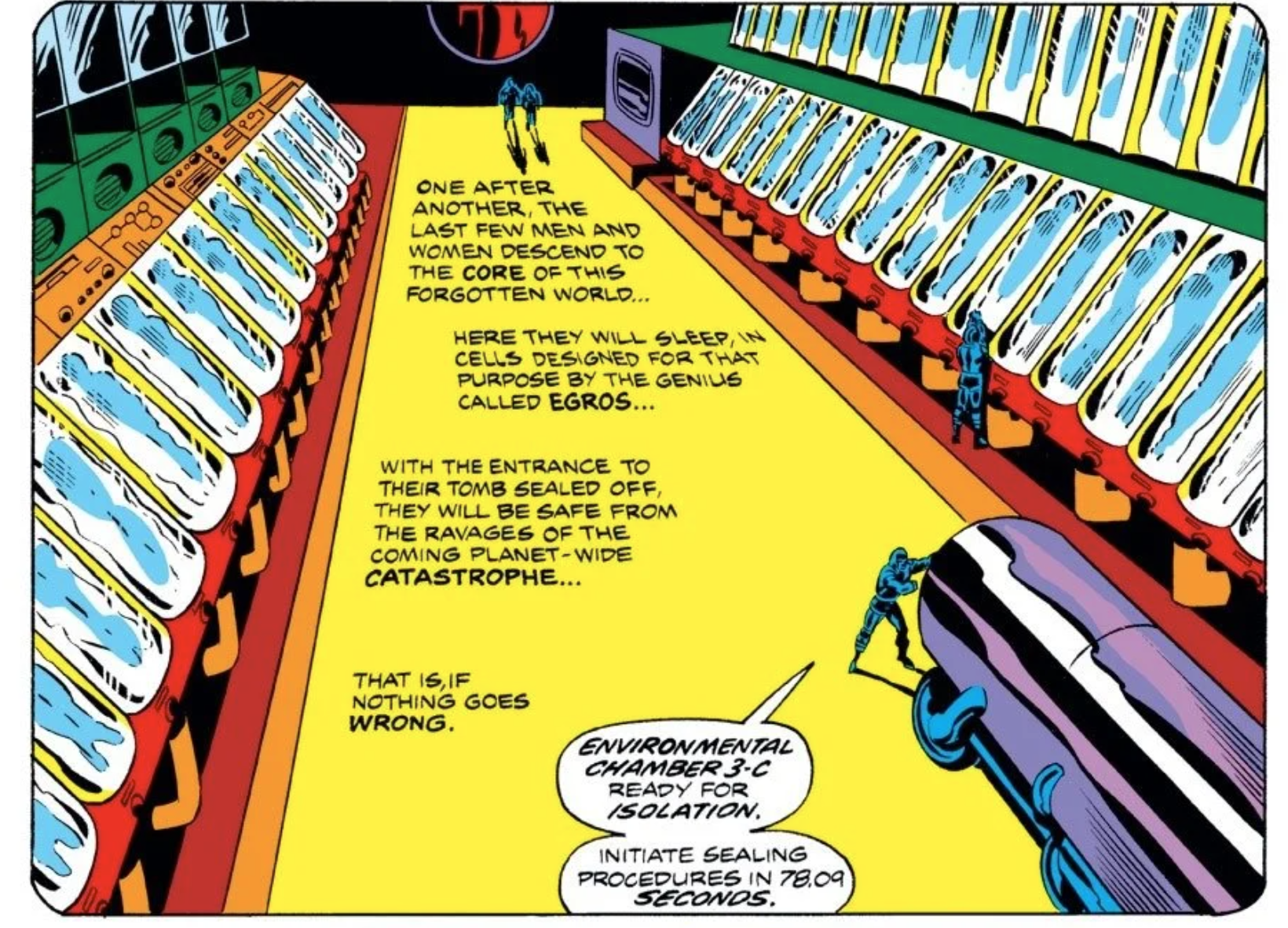
But something goes wrong, and Egros becomes the planet. Then someone stole a piece of him and he went insane.
I go into detail about this issue because it reminds me of Beta Ray Bill’s backstory, about a member of a dying race having to find a way to save everyone else. In Bill’s case he is their protector and tasked with finding a new home planet, but it’s still a striking similarity.
The Ego 3-parter ends, and we’re given complete tonal whiplash in #229.
Everyone in Manhattan is insane now.
People are committing arson, blowing other people up with comically titled boxes of TNT and a guy hijacks a plane to fly it into the side of a building.
Hercules also falls victim to the strange man turning people insane, seemingly getting plunged into the depths of hell before returning a changed man. But he’s fixed by the loving touch of a woman…..
Thor and Herc go fight demons who are clearly being puppeteered by a much bigger, much eviler force. But we don’t get to know what that is yet. (I don’t think we ever get to know what that is it’s just another plot thread that goes nowhere.) Instead we are hit with a BIG TWIST!
Remember when everyone went insane? Me neither. But apparently when that happened, my beloved, beautiful, object of my obsession Jane Foster, who I am very normal about. Is brought back from being written out of the book nearly 100 issues ago for those sweet sweet melodrama points.
She… tried to kill herself while everyone went insane. That’s awesome. We love that. So she’s in a hospital in Manhattan (despite the fact she was dropped off on the West Coast the last time we saw her.)
This is where the issue surprises me. We see that Thor is obviously upset over Jane’s condition, and Sif oversees this. And instead of running away and crying or yelling at Thor, when told by the doctor that Jane is on her deathbed, Sif returns to Asgard (where she and Hildegard see that Odin is missing, poor guy must have wandered off somewhere.) Where she plans to do anything in her power to save Jane.
Sif’s determination to go out of her way to save Jane is very admirable. She does only do this because she doesn’t want Thor to be upset, but it does show us that she is someone who can be a bit rash in her decision-making and who will go to great lengths to save others. I like this characterization a lot! And sadly we get this moment of characterization before learning a few issues later that Sif and Jane must merge into one being.
Why.
I would like them both to exist at one time. I like them both existing at one time. Did Conway not to bother with a love triangle? I feel like there really wouldn’t have been one if he chose to keep Sif in her own body. Just have Jane thank her and continue being a side character that shows up sometimes while retaining the Thor and Sif relationship.
It’s a baffling decision to be sure, but the decision is made during an arc where Loki returns after being banished in Avengers #118. So yay, Loki is back and the Avengers are here! So is the Army… and… Odin is on a farm because he doesn’t remember who he is? Odin literally went to a farm upstate.

Oh yeah, and there’s another Loki costume change. This mini-arc ends with Thor beating Loki in hand to hand combat and everyone celebrating. But Thor isn’t in the mood for celebrations… he’s in the mood to brood.
Jane’s condition is really eating up at Thor, and we get an entire splash page of him being upset about it in the beginning of 235. He’s upset about her being on her deathbed, and pissed at Odin for screwing everything up. It’s a little bit strange to see Thor in this era feel anything but reverence towards Odin. But it’s interesting seeing that Jane is able to stir up those conflicting emotions he may have towards his father.

It’s more of a modern thing for Thor to have a bad relationship with Odin, so seeing the seeds begin to be planted all the way back here is interesting to me. But yeah Thor, Odin can’t hear you because he has dementia and is on a hippie farm.
Meanwhile Sif and Herc are still trying to figure out how to save Jane, and they find themselves in a strange other galaxy to find the mysterious Kamo Tharnn.
Now this is the sort of weird out there space stuff I enjoy, the blending of mythos and sci-fi to create strange otherworldly places and meet weird characters. Buschema pulls out all the abstract stops here, drawing a place that really does feel otherworldly (and a bit like a Super Mario Sunshine special level. You know the ones with the a cappella music?)
Herc fights off Kamo Tharnn and takes his lionheaded staff, where both he and Sif are transported back to Earth, all while Thor is in the midst of battle with the Absorbing Man.
Sif says that she doesn’t want to see Thor’s heart shattered, so she uses the Staff to essentially transfer her consciousness into Jane’s body, so that her life force can be used to revive Jane.
Again. A weird writing decision, having to remove one character from the book to bring in another.
Jane and Sif have always been in this strange sort of limbo, where for some reason the writers can’t decide on what they want and don’t understand that you’re allowed to have two female characters around at the same time. Maybe Sif could have revived Jane without having to vanish and could have left for a time to clear her head? Or maybe Jane could thank them all but say that Sif and Thor should remain together, and that she’ll support them.
As mentioned before, I love Jane a lot. She’s my favorite Marvel character, but I don’t like seeing other characters get put down. Especially characters that I like a lot as well. It’s a complicated feeling, but overall I think I like this arc, despite the weird writing decisions.
We’ll have Jane stick around a bit longer. Now the hunt for Odin begins.
To insert another aside here, these issues have the letters still in the back. And I love reading what other comic readers had to say all the way back in 1975. There’s one guy pointing out a continuity error with a character being on an elevator in one panel but not on another, there’s another person saying that women can’t be carriers of hemophilia, and marvel replying with ‘Loki did it! Loki did it!’ I also can’t believe that people would just let their entire addresses be printed! I suppose that is something strange to see in the age of the internet, but it really is baffling seeing people’s full on street addresses and zip codes posted right after their full government names.
I’ll be skipping the issues where Jane is a prominent side character, not because I hate them, but because they’re really just normal run of the mill comic stuff. Villain of the week romps that don’t have very high stakes or big drama. I have to say that the late 230’s are when Buschema’s art really begins to shine. I love how expressive everyone he draws are, and it’s really amazing seeing all the different denizens of New York populate the pages. Plus in issues 238, 244 and 246 Jane legit gets down and dirty and kicks some ass.
Alas, Jane vanishes again in 249, when she suddenly hits the hilt of a sword against a wall and Sif is brought out from her body. Meaning that Jane is inside Sif, and Sif is now on the outside. I visualize this as Jane suddenly being teleported to a very nice living room and just going like ‘welp, this is out of my control.’
More pressing matters happen in the 240s. And these are not plot related. But writer related. As of 239 Conway is off the book. He is not writing it anymore. Sal and John Buscema are still doing the main pencils, but now the book is being passed around writers. Mainly Roy Thomas and Bill Mantlo.
And it is obvious that there is a shakeup in the bullpen. The writing quality takes a bit of a hit in the midst of an arguably uninteresting time travel arc with Ancient Egyptian themed villains (What is with Marvel and time traveling Egyptians?) Until Len Wein is brought on as the main writer for the rest of the 70s.
And proceeds to write the worst Thor run so far.
The 70s were already mid, but the mid-70s are really starting to slip. There are even reprints of old Lee/Kirby issues with new covers.
Wein falls into the trap of overly complicated and arguably stupid sci-fi plots. Including bringing back the Stone Men from Saturn. The coolest Thor enemies ever.
I especially find it hard to say what I dislike about Wein’s writing. But I think one of my main issues arises from his use of bringing back lame characters and writing SO. MUCH. EXPOSITION.

We definitely wanted to go back to the Black Stars and hear characters explain what they are doing in that moment out loud, as if comics aren’t a visual medium where that isn’t required.
Hell, there’s an arc about a tentacle monster who’s actually not a bad guy but they killed it anyway because you should never judge a book by its cover! Anyway the thing is dead and the people living on the planet it was on are now going to suffer greatly after it’s loss.
BUT DO YOU WANT TO SEE GREY GARGOYLE IN SPACE?
Oh yeah, Walt Simonson (Yes, that Walt Simonson) is currently the main penciler as of issue 260. Something I quite like seeing among the midst of this story about going to the edge of the universe and finding weird blue people but actually everyone was a ghost and its fine now don’t worry about it.
After the mess with the StarJammer and the Soul Survivors and the Doomsday Star, we’re finally back in Asgard, and this time Loki is on the throne. Again. Because Odin is sleepy.
But now we are told of the coming of Ragnarok, all while Loki sits back and laughs about Thor getting beat up by the destroyer, who is currently being piloted by Balder’s spirit.
But thanks to the combined efforts of the Warriors Three and Karnilla, Odin is awakened and Balder’s spirit is freed. Yay! Everything is back to normal and we can return to Midgard.
Issue 267 is another issue to point out, not because it’s particularly good or anything, but because it’s the first time Sif is seen wearing her red outfit!

I love red and Sif looks good in red.
Also Loki is forcibly sent to Midgard as a homeless man in this issue. And Donald Blake’s office building was turned into a parking garage.
While in Midgard Thor reads a newspaper and fights Stilt Man. He also fights a villain that looks a lot like Kalibak from Kirby’s Fourth World. The late 260s are genuinely some of the most nothingburger comics I’ve ever read. And they’re not worth anyone’s time.
Though there is a standout with issue 272, which is an issue that Ewing retold in it’s entirety in Immortal Thor while making a few changes to his story. So I would check that out for those of you who did enjoy Immortal Thor, because it’s fun drawing those parallels.
Also in 272, Roy Thomas took over as the main writer.
Two issues later in 274, we begin the arc that I have the biggest gripes with. And that is the arc where Thomas suddenly decides that he wants everything to be mythologically accurate.
We are introduced to so many new characters and stories from the Poetic Edda within the span of a few issues that it really does begin to get tiring. As mentioned above, I don’t want my Thor comics to be a complete 1-to-1 retelling of the myths, but that is what Thomas is trying to do in issues 274-278.
Wein even brings in a surrogate character to act as the ‘mythological’ Thor, a redheaded barbarian of a man who closely resembles that of historic depictions of the god.
But this Thor is just a camera man. Because for this entire arc there is a human news crew filming Ragnarok. They film the death of Balder, the awakening of Jorgarmundr, and the return of Hela’s army of the dead. They comment on what actually happened in Norse Myth and are just there to explain things to the audience.
It feels so… pedantic. Again. If I wanted to read Norse Myth, I’d read Norse Myth.
In Thor comics, I like the concept of Ragnarok. But I like how it was done in the JMS run, happening after a great disaster where everyone is left to pick up the pieces. People may die and be reborn, but there is a definite change. Beyond just what we know from the myth.
As Ewing says, the wheel turns.
In January of 1979, Thomas steps back from Thor and we get 4 issues not written by him which are not worth even talking about before Thomas returns with a huge Eternals Crossover event.
Now, I was not familiar with the Eternals before I got to issue 283, so I took a bit of a break and read Eternals.
I liked it, It felt like diet Fourth World but it was by Kirby and I love Jack Kirby. (this doesn’t have anything to do with this retrospective I just like my asides)
Thor meets the Space Gods and the other Eternals, where he battles some of their villains alongside them. It’s more of a rehash of what Kirby wrote about in the standalone series, so I’m not sure what Thomas is really trying to accomplish with this.

Mostly unrelated but we’re getting judged by Arishem this year. Woo hoo!
Thor fights deviants in NYC and the rest of the Eternals join Thor in his battle. This really wouldn’t have much meaning to me if I hadn’t read Eternals before this, but I like Thor interacting with them. Plus there’s the B-Plot with Sif and the other Asgardians fighting off giants and dragons while Karnilla attempts to revive Balder.
It’s even revealed that Odin swore allegiance to Arishem before the Celestials went down to Earth. Which really bothers Thor.
While Thor was on Olympia, a home of the Eternals, Odin goes to Mt. Olympus to meet with Zeus, directly mirroring Thor’s earlier conversation with Zuras. Where Odin asks to make an alliance with the Olympians in order to stop Arishem from delivering his judgement.
Thor returns to the rainbow bridge outside of Asgard in a temper, threatening to fight anyone who gets in his way so he can get the truth from Odin. Even going as far to fight Sif, who put her own soul in the body of the Destroyer (ok?) to stop him.
So now Thor has been thrown to Midgard where he…
Fights Luchadores.
Okay.
And with that the 70s are over! The Eternals storyline wasn’t resolved in this decade and instead we ended on a filler episode!
If I were a dick, I would stop here.
But I’m not.
There’s a huge fight between the Eternals and the Greek Gods that they are named after, as well as Thor vs. Odin. Where the entire crossover arc essentially ends with Zuras going ‘Welp. We’re gonna do our own thing. Bye.’

And thus. The Eternals crossover arc is ended. And we are not in the 70s anymore.
What are my final thoughts on this decade? Is is worth reading as a modern comics fan?
I mean, I didn’t regret it. I had fun.
It was comics, they’re stupid and sometimes bad, but I was entertained. I got to see Jane and a bunch of fun little cameos from the other Avengers and I believe there were some pretty solid arcs between all the sci-fi bullshit.
Now I move on to the 80s, where I get to re-read one of my favorite Thor runs, which is the Simonson run. Which is very exciting.
Maybe I’ll write another retrospective for the 60s and for the 80s, but for now. I’m done and my wrists hurt.
Thanks for reading! Please feel free to reach out on social media or through my contact page, which has my email and my discord.
Have a wonderful night/day/evening/morning/afternoon.